Rapid Industrial FastenersRapid Industrial Fasteners
 May 26, 2026
Within the UK’s most demanding industrial sectors, few components carry the weight of responsibility, both literally and figuratively, like the B7 stud. Specified daily across the petrochemical, oil and gas, defence, and pressure vessel industries. A critical component upon which the integrity of entire systems depends.
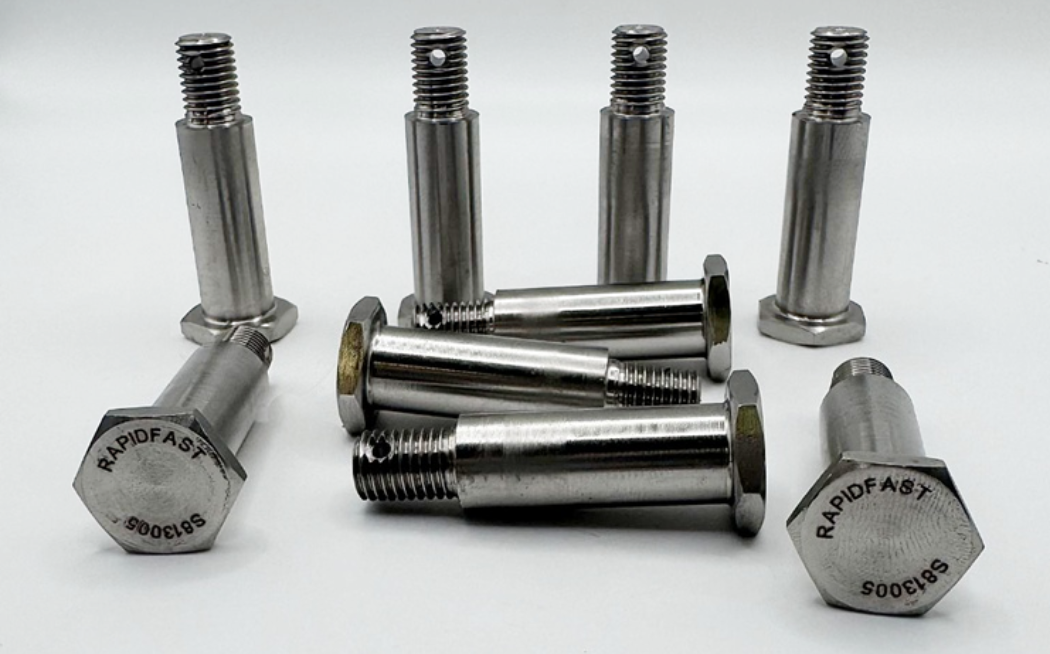
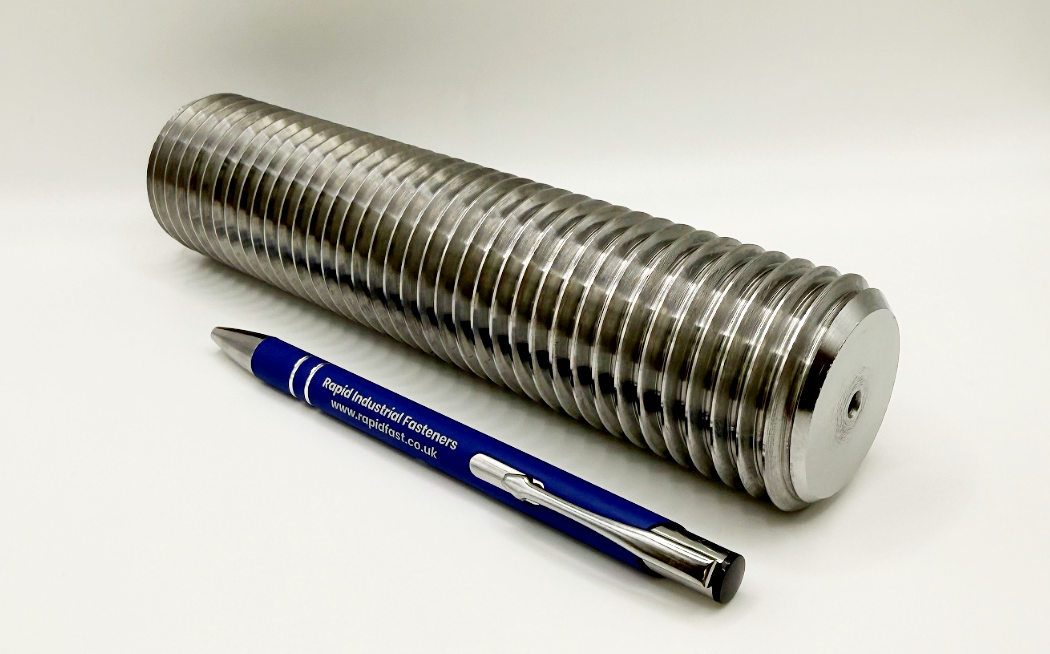
Our in-house manufactured 1.3-4 UNC x 7.1-2 B7 studs, produced from L7 bar stock, represent precisely this class of component. Precision-engineered fasteners built to meet the uncompromising demands of Britain’s most technically rigorous industries.
B7 is the specification that governs alloy steel bolting materials for high-temperature or high-pressure service, as well as other special purpose applications.
The B7 designation refers to a chromium-molybdenum alloy steel, that delivers exceptional mechanical performance under demanding conditions. It is one of the most widely specified stud materials in the global oil and gas, petrochemical, and pressure vessel sectors. Its presence on engineering drawings and procurement schedules across the United Kingdom is pervasive.
L7 is chemically similar to B7 in terms of its chromium-molybdenum composition, yet is subject to additional impact testing requirements that qualify it for use at significantly reduced temperatures. This distinction is fundamental and speaks directly to one of the most critical performance requirements in cryogenic, subsea, and cold-climate applications.
The mechanical performance of these studs is defined by figures that speak for themselves. With a minimum tensile strength of 125,000 psi, these studs are engineered to maintain their structural integrity under levels of mechanical loading that would compromise lesser materials entirely.
To contextualise that figure. 125,000 psi equates to approximately 862 megapascals. For reference, standard mild steel fasteners commonly used in general construction applications typically offer tensile strengths in the range of 400 to 500 megapascals. Our alloy studs deliver tensile performance approaching double that of standard mild steel. A differential that is not just academic when our fasteners are holding together flanged joints in high-pressure pipework, pressure vessel closures, or critical subsea infrastructure.
This level of tensile strength is achieved through the specific alloy chemistry of the chromium-molybdenum steel and the heat treatment process. Quenched and tempered is applied during manufacture. The resulting microstructure delivers not only a high ultimate tensile strength but also a favourable combination of yield strength and ductility. These studs resist both sudden fracture and progressive deformation under sustained or cyclical loading.
For the structural integrity engineer or the pressure system designer, these are not abstract properties. They are the numbers upon which joint efficiency calculations, bolt load assessments, and pressure test protocols are built. Getting them right is not optional. It is the foundation of every safe bolted assembly in pressure-containing systems.
If the tensile strength credentials of these studs are impressive, it is their performance at extreme low temperatures that perhaps most clearly distinguishes them from standard alloy fasteners and explains their particular prevalence in the sectors we serve.
The L7 material designation specifically addresses the challenge of low-temperature toughness, a property that is not automatically retained by high-strength alloy steels as temperatures fall. Many steels that perform admirably at ambient or elevated temperatures become progressively brittle as temperatures drop, exhibiting a phenomenon known as ductile-to-brittle transition. In safety-critical applications, this transition can have catastrophic consequences.
L7 is impact tested to ASTM A320 requirements at -150°C, demonstrating that it retains the toughness necessary to absorb energy and resist brittle fracture at temperatures far below anything encountered in standard industrial service. Our studs, manufactured from this certified bar stock, carry this low-temperature performance validation, as an inherent characteristic of the material and its certification.
Looking further along the temperature scale, the theoretical lower boundary of -273°C approaching absolute zero, places these studs in the context of the most extreme cryogenic engineering environments imaginable. Applications involving liquid nitrogen, liquid hydrogen, and liquefied natural gas infrastructure all demand fastening solutions that remain tough and reliable at temperatures where many engineering materials become dangerously unpredictable.
The combination of B7 and L7 material properties addresses this challenge with the authority of decades of proven industrial service.
For the UK’s growing LNG sector, for defence applications involving cryogenic fuel systems, and for the specialised pressure vessel work associated with the gas processing and petrochemical industries, this low-temperature performance is not a niche consideration, it is a primary specification driver.
The UNC (Unified National Coarse) thread form applied to these studs is a detail worth addressing directly, particularly in the context of the UK market where metric thread standards have been dominant in general engineering for several decades. The continued specification of imperial thread forms in the sectors we serve is not an anachronism or an oversight. It is a deliberate and entirely rational product of the international standards frameworks within which these industries operate.
The oil and gas, petrochemical, and pressure vessel industries globally are governed to a significant degree by American standards bodies (ASTM, ASME, ANSI, and API among them). These standards, which define the material, dimensional, and performance requirements for everything from flanges and valves to the fasteners that hold them together, were developed within the imperial measurement system and have not been metricated in the intervening decades. The ASME B16.5 flange standard, for example, which defines most flanged pipeline connections used in UK oil and gas infrastructure, specifies UNC threaded studs as the standard bolting arrangement.
As a result, a 1.3-4 UNC stud is not an unusual or difficult specification in these industries. It is precisely what the drawing calls for. The ability to manufacture this thread form accurately and consistently, to the dimensional requirements of the relevant standards, from certified alloy bar stock, is a core competence that the industries in question require from us.
It is worth pausing to acknowledge the broader context of British engineering excellence within which discussions of this kind sit most naturally. The United Kingdom has a proud and deep-rooted tradition of contribution to the science and practice of mechanical fastening. A tradition that stretches back to the Industrial Revolution and the work of engineers whose innovations underpinned the development of modern engineering standards.
Joseph Whitworth, the Manchester-born engineer whose standardisation of screw thread forms in the mid-nineteenth century effectively created the first coherent national thread standard, is perhaps the most celebrated figure in the history of fastener standardisation. Whitworth’s insistence on precision measurement, his development of the measuring machine capable of accuracy to one millionth of an inch, and his advocacy for standardised thread profiles across British industry laid the intellectual and practical foundations upon which all subsequent thread standardisation (including the UNC system used in today’s B7 studs) was built.
The spirit of Whitworth’s approach, precision, standardisation, traceability, and an understanding that the reliability of the whole depends upon the integrity of every individual component, is one that resonates directly with the principles governing the manufacture and specification of safety-critical alloy studs in the twenty-first century.
Lead time and capacity.
Manufacturing in-house from our vast bar stock gives us the flexibility to respond to both standard scheduled orders and urgent requirements with a degree of agility that reliance. We maintain stock of certified L7 bar and are able to discuss specific requirements, quantities, and timescales directly with our customers.
The specification of alloy studs for safety-critical applications is not always a straightforward process, and questions around material grade selection, dimensional standards, coating requirements, and certification documentation are ones we are well equipped to support.
For further information, technical enquiries, or to discuss your specific requirements for B7 and L7 alloy studs, please contact our team today.
See us in action 🎬

© Rapid Industrial Fasteners Limited.
All rights reserved. All content on this website, including text, images, graphics, logos, product descriptions, downloadable documents, and any other materials, is the intellectual property of Rapid Industrial Fasteners Limited unless otherwise stated.
No part of this website may be reproduced, distributed, modified, transmitted, or stored in any form without prior written permission from Rapid Industrial Fasteners Limited.
You may view, download, and print content for personal or internal business use only. Any commercial use, republication, or redistribution of content is strictly prohibited without express consent.
Unauthorised use of this website’s content may violate copyright, trademark, and other applicable laws.
Website by FolcraTech
© Rapid Industrial Fasteners Limited. All rights reserved. Privacy policy