Rapid Industrial FastenersRapid Industrial Fasteners
 October 22, 2026
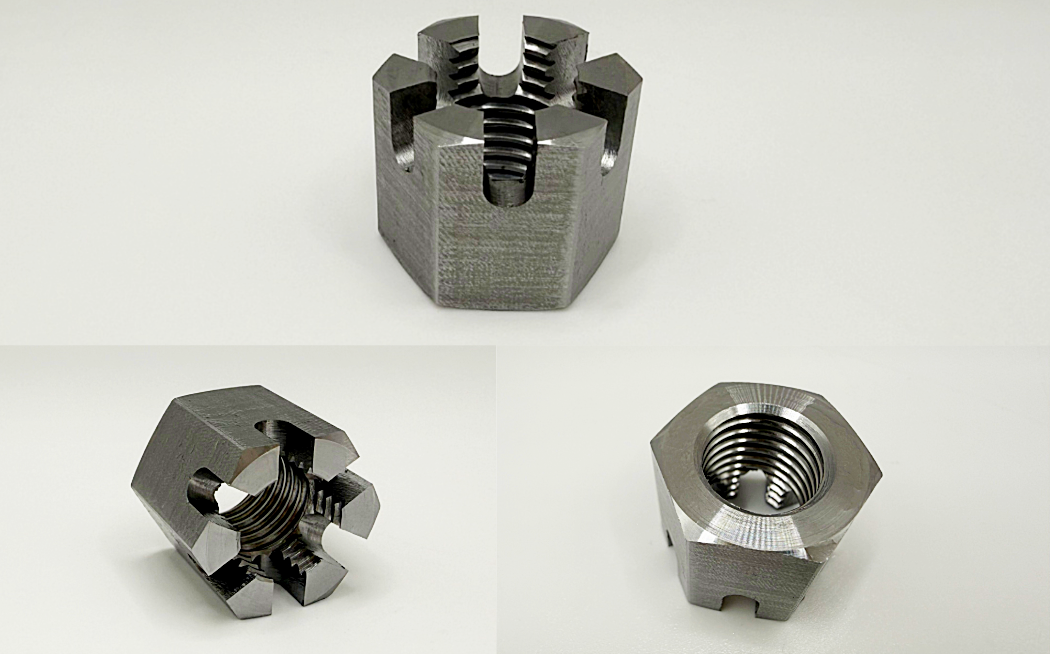
M16 Grade 8 Slotted Castle Nuts. A fastener whose distinctive crown design has been quietly holding critical assemblies together since the dawn of the motor age and shows no sign of being replaced any time soon.
At the turn of the twentieth century, engineers building the first automobiles and aircrafts faced a persistent and dangerous problem: nuts worked themselves loose under sustained vibration. Long before thread-locking compounds, nylon inserts or spring washers existed, the answer was mechanical and absolute — physically prevent the nut from rotating at all.
The castle nut, sometimes called a castellated nut for its resemblance to the crenelated battlements of a medieval fortress, first appears in engineering literature in the early 1900s. Its solution was as elegant as it was uncompromising. Cut precise slots into the crown of the nut, drill a corresponding hole through the bolt shank, and pass a split pin or cotter pin through both. Once fitted, the nut cannot back off under any amount of vibration, shock loading or cyclic stress. It is physically locked in place, full stop.
More than a century later, and despite huge advances in adhesive thread-locking and mechanical locking washers, this principle remains unbeaten for the applications that matter most. Steering knuckles, wheel hub assemblies, suspension components, aerospace fixings, structural bolting on rotating plant, engineers still reach for a castle nut and a pin.
Our M16 castle nuts are made from quenched and tempered ASTM A193 L7 alloy steel, delivering high tensile strength and excellent toughness. It’s a material more commonly associated with pressure vessel flanges, valve assemblies and high-pressure piping than everyday fastener stock. Which is precisely why it’s specified where a standard mild steel nut simply won’t hold its own.
Combined with a Grade 8 property class, these nuts are engineered for applications carrying substantial tensile and shear loads. This is not a fastener for light-duty brackets. It’s specified where rotational loosening under load would be catastrophic rather than merely inconvenient.
With a 24mm AF and 22mm height, M16 castle nuts are commonly specified for automotive, off-highway, structural, and engineering applications requiring positive mechanical locking.
For applications exposed to vibration, cyclic loads or torque reversal, a Grade 8 L7 castle nut with a split pin offers a simple, proven and auditable locking solution. There’s no adhesive cure time, no washer that can fatigue and lose its spring, and no ambiguity on inspection.
If you’re looking for expert advice and quality manufacturing, our teams are ready to assist.

© Rapid Industrial Fasteners Limited.
All rights reserved. All content on this website, including text, images, graphics, logos, product descriptions, downloadable documents, and any other materials, is the intellectual property of Rapid Industrial Fasteners Limited unless otherwise stated.
No part of this website may be reproduced, distributed, modified, transmitted, or stored in any form without prior written permission from Rapid Industrial Fasteners Limited.
You may view, download, and print content for personal or internal business use only. Any commercial use, republication, or redistribution of content is strictly prohibited without express consent.
Unauthorised use of this website’s content may violate copyright, trademark, and other applicable laws.
Website by FolcraTech
© Rapid Industrial Fasteners Limited. All rights reserved. Privacy policy